
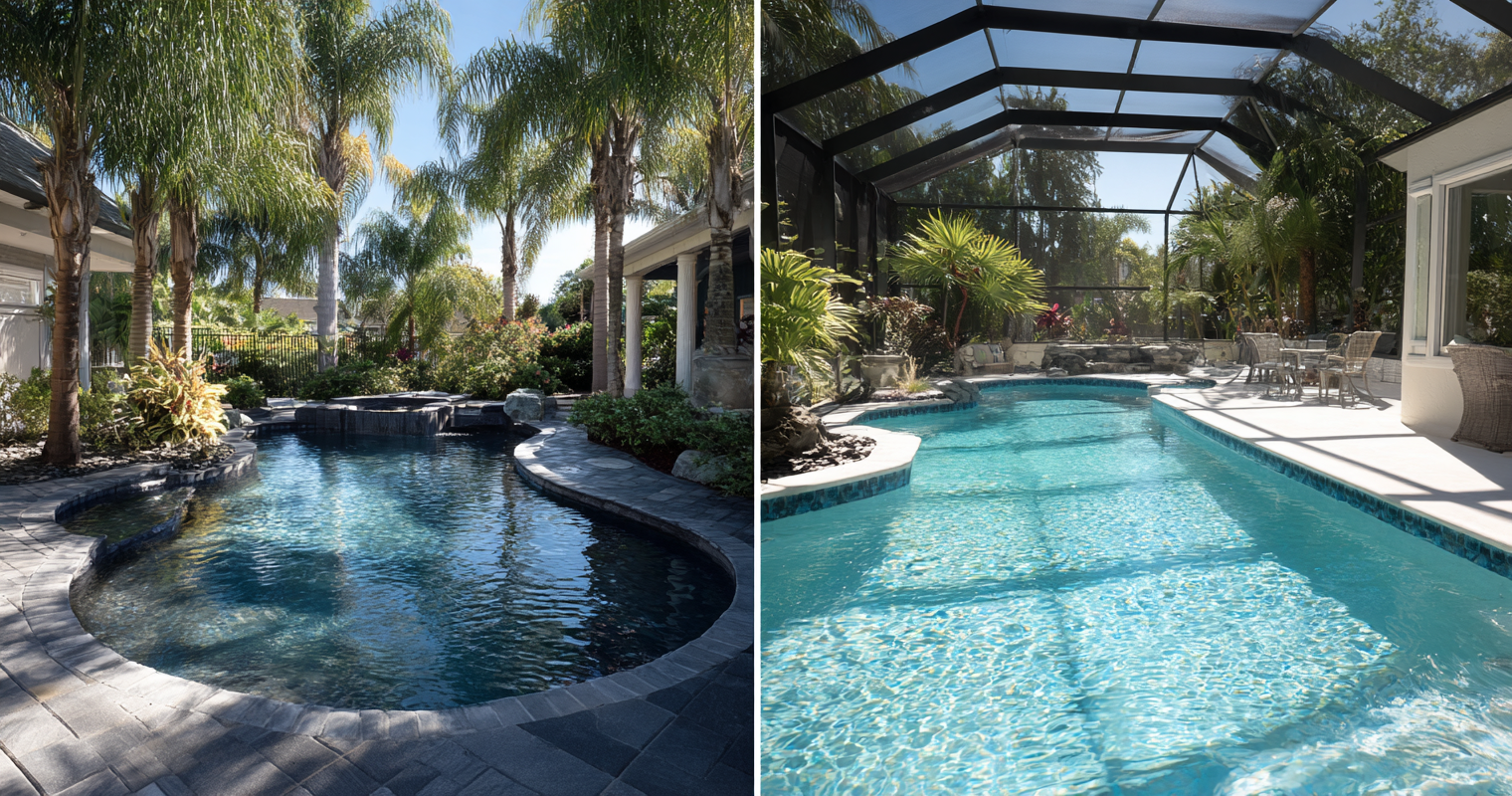
Pool and Spa Combo Designs for Fort Myers Homes
A shared-wall spa costs far less than a separate one — and the heating decision matters more than the design.
Pool and spa combo designs for Fort Myers homes are popular for a straightforward reason: building the spa at the same time as the pool, sharing a wall and an equipment pad, costs dramatically less than adding a separate spa later. The structural work, plumbing, and equipment are largely shared.
The design choices are mostly about height and spillover. The decision that will actually affect your enjoyment and your bills is heating.
Raised, Flush, or Fully Separate
Raised spa with spillover is the most common Fort Myers configuration and generally the best value. The spa sits elevated above the pool, sharing a structural wall, and water spills over the edge into the pool. You get moving water and its sound whenever the pump runs, plus a raised feature that gives the pool visual structure. The raised wall also doubles as seating.
Flush or in-line spa sits at the same level as the pool deck, integrated into the pool outline. It reads as cleaner and more contemporary and suits modern architecture. Without the height difference you lose the spillover effect, and the spa is less visually distinct.
Fully separate spa gives placement freedom — closer to the house, on a lanai, or tucked into a private corner. It costs the most, because nothing is shared: separate structure, separate plumbing runs, often separate equipment.
For most Fort Myers backyards, the raised spillover spa is the sensible default: the best combination of cost, visual impact, and usability.
Heating Is What Actually Matters
In Southwest Florida the pool is comfortable much of the year without heat. The spa is not — a spa is only worth having if it reaches 100 to 104 degrees reliably and reasonably quickly. This is where combos are most often specified badly.
Gas heaters heat a spa fast, typically bringing it to temperature in well under an hour. That responsiveness is the whole point of a spa. Running cost per session is higher, but you only heat it when you use it.
Heat pumps are far more efficient for maintaining a large body of water at a moderate temperature, which makes them excellent for pools. They are slow to bring a spa to spa temperature — hours, not minutes — which in practice means people stop using the spa spontaneously.
The arrangement that works best for most households: a heat pump for the pool and a gas heater for the spa, or a gas heater sized to serve the spa quickly. Specifying a single undersized heat pump to do both is the most common regret in this category.
What to Confirm Before You Sign
Ask for the spa's seating capacity and actual dimensions, not just 'spa'. Spas vary considerably and a spa that seats four comfortably is a different build from one that seats six.
Confirm how the spa is isolated hydraulically. A properly built combo can heat and run the spa independently of the pool. If the systems are not properly separated, you end up heating the entire pool to enjoy the spa, which is expensive enough that people simply stop.
Check jet count, jet placement, and blower inclusion. Ask whether the spa has its own dedicated pump. And confirm automation: being able to start heating the spa from your phone on the way home is the difference between a spa that gets used and one that does not.
Finally, get the heater type and size written into the contract explicitly. 'Heater' as a line item is not a specification, and heating is the decision that determines whether the spa earns its place.
Related Pool Topics
Frequently Asked Questions
How much does adding a spa to a pool cost in Fort Myers?
Building a spa at the same time as the pool costs far less than adding one later, because the structure, plumbing, and equipment pad are shared. The exact figure depends on size, configuration, and heater specification.
Is a raised or flush spa better?
Raised with a spillover is the most common Fort Myers choice and usually the best value. It gives moving water, visual structure, and extra seating from the raised wall. A flush spa looks cleaner and more contemporary but loses the spillover effect.
What heater do I need for a spa in Florida?
A gas heater for the spa, in most cases. Gas brings a spa to temperature in well under an hour. Heat pumps are efficient for maintaining pool temperature but take hours to reach spa heat, which stops people using the spa spontaneously.
Can I heat the spa without heating the whole pool?
Only if the systems are properly isolated hydraulically. A well-built combo runs and heats the spa independently. Confirm this explicitly, because heating the entire pool to use the spa is expensive enough that owners give up on it.
How long does a spa take to heat up?
With an appropriately sized gas heater, typically well under an hour. With a heat pump sized for the pool, it can take several hours, which is the single most common complaint about poorly specified combos.
Do I need a separate pump for the spa?
A dedicated spa pump gives better jet performance and lets the spa run independently of pool circulation. It is worth asking about specifically rather than assuming it is included.
Can fiberglass pools include a spa?
Some manufacturers offer moulded shells with an integrated spillover spa. You are limited to the catalogue configurations. For a spa of a specific size, height, or position, gunite is the only way to get exactly that.
Is a pool and spa combo worth it for resale in Fort Myers?
A well-built combo is generally viewed positively in this market, particularly a raised spillover spa which reads as a design feature rather than a bolt-on. Poorly specified spas that are slow to heat add little, because buyers who test them notice.