
Pool Waterfall Features Cost and Maintenance in FL
From a $1,000 sheer descent to a $15,000+ rock feature — what each costs to run, and why so many get switched off.
Pool waterfall features cost anywhere from about $1,000 for a simple sheer descent to $15,000 and beyond for a constructed rock feature. That range is wide because the term covers everything from a slot in a raised wall to an engineered boulder structure with its own pump and plumbing.
Before choosing, it is worth knowing the pattern: water features are among the most enthusiastically bought and most quietly abandoned pool additions. Understanding why helps you pick one you will actually run.
What Each Type Costs and Delivers
Sheer descent — a slot fitted into a raised wall producing a clean, flat sheet of falling water. Typically $1,000 to $3,000 per unit. Contemporary, quiet in a pleasant way, and low maintenance because there is little structure to age. The most reliable value in the category.
Spa spillover — water flowing from a raised spa into the pool. If you are building a spa anyway, this is effectively a free water feature. It is also the one people keep running, because the spa needs circulating regardless. The best-value water feature in Southwest Florida by a wide margin.
Scupper or spout — water arcing from a wall-mounted fitting. Usually $500 to $2,000 each, and often used in pairs or threes on a raised wall. Simple, effective, easy to maintain.
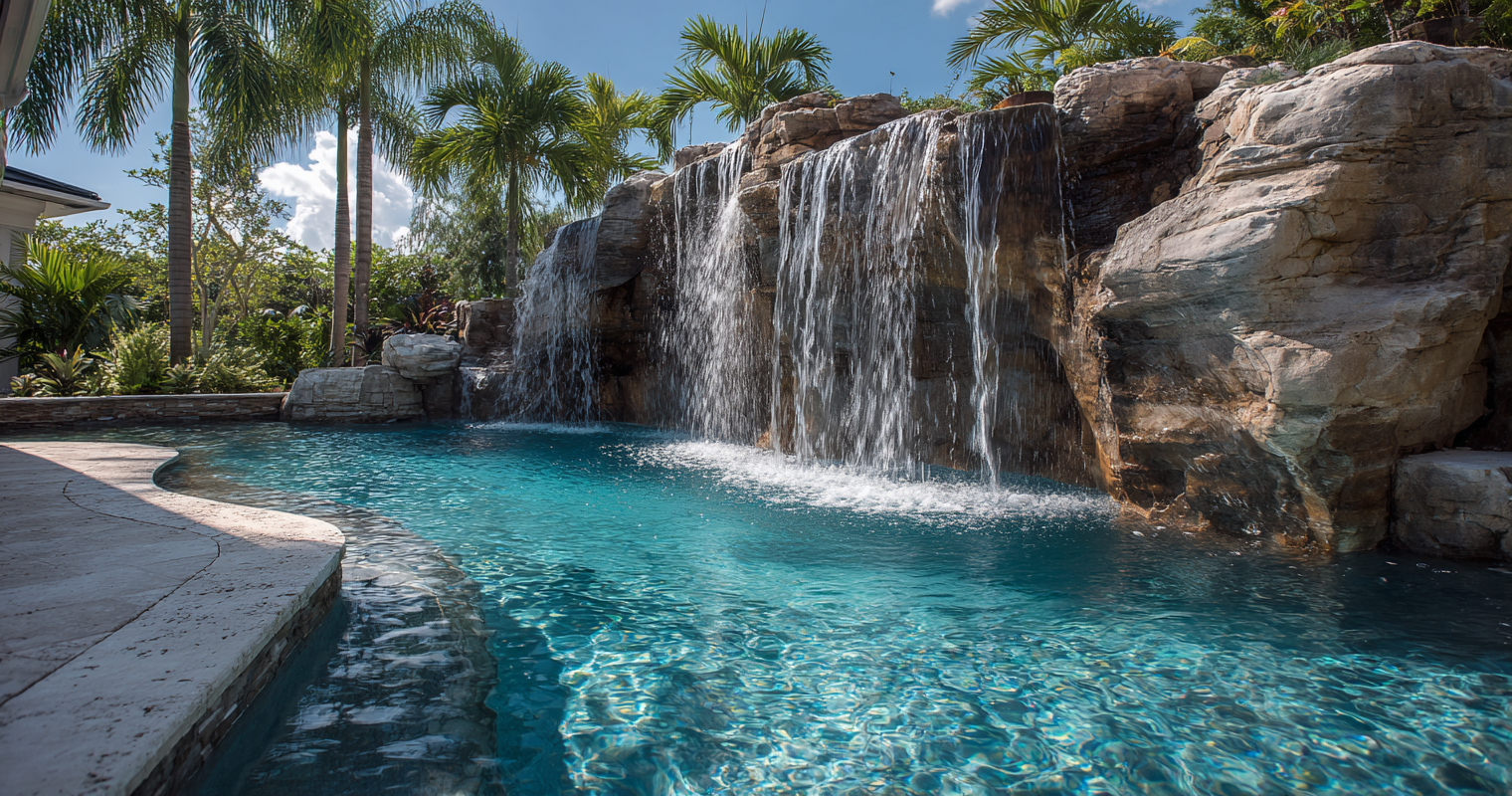
Rock waterfall — constructed boulders, real or artificial, with water flowing over them. Commonly $5,000 to $15,000 and upward. Visually dramatic, and the type most likely to be abandoned once the running cost and noise sink in.
Grotto — a rock structure with a cavity behind the falling water. Substantially more, typically $10,000 to $40,000 or more, with engineering requirements that make it infeasible on many lots.
The Cost Nobody Quotes You
Most waterfalls beyond a simple spillover need a dedicated pump, and that pump uses electricity every hour the feature runs. On a large rock waterfall this is not trivial, and it is the most common reason features stop being used.
Evaporation is the second cost. Moving water and airborne spray evaporate far faster than a still surface, and in Southwest Florida heat that means noticeably more top-up water and more chemical adjustment. An auto-fill becomes close to essential.
Then there is noise. In a showroom or a video a waterfall sounds wonderful. Beside a lanai where you are trying to hold a conversation or take a call, a large feature is loud, and larger features are louder than buyers expect. Sheer descents and spillovers produce a gentler sound that people tolerate long term; big rock falls often do not.
Finally, hard water. Southwest Florida water leaves calcium deposits, and constantly wetted surfaces are exactly where scale accumulates and shows. Rock features with lots of surface area need regular cleaning to avoid a chalky white build-up.
How to Pick One You Will Keep Using
If you are building a spa, take the spillover and consider the water feature question answered. It costs almost nothing extra, it runs whenever the spa circulates, and it delivers the movement and sound most people actually want.
If there is no spa, a sheer descent or a pair of scuppers on a raised wall is the sensible choice: modest cost, modest running expense, contemporary look, and low maintenance.
If you want a large rock feature, go in with clear expectations. Ask what the dedicated pump draws, listen to a comparable installation in person before committing, and confirm the feature can be run independently of pool circulation so you are not forced to choose between filtration and silence.
One practical detail worth insisting on: every water feature should be on its own valve and, ideally, its own automation control. Being able to switch it on for guests and off the rest of the time is what keeps a feature in service rather than permanently dormant.
Related Pool Topics
Frequently Asked Questions
How much does a pool waterfall cost in Florida?
From roughly $1,000 to $3,000 for a sheer descent, $500 to $2,000 for a scupper, $5,000 to $15,000 or more for a constructed rock waterfall, and $10,000 to $40,000 or more for a grotto. A spa spillover is effectively free if you are already building a spa.
What is the best value pool water feature?
A spa spillover, if you are building a spa anyway. It costs almost nothing extra, runs whenever the spa circulates, and delivers the water sound and movement people actually want. Sheer descents are the best value where there is no spa.
Do pool waterfalls cost a lot to run?
Larger ones do. Most features beyond a spillover need a dedicated pump drawing electricity for every hour they run, and moving water increases evaporation and chemical demand. This is the main reason rock waterfalls get switched off.
Are pool waterfalls noisy?
Larger ones are louder than buyers expect. Sheer descents and spillovers produce a gentle sound most people live with happily. Big rock falls can make conversation difficult on an adjacent lanai — listen to one in person before committing.
Do waterfalls increase evaporation?
Yes, noticeably. Moving water and airborne spray evaporate much faster than a still surface, especially in Southwest Florida heat. Expect more top-up water and more chemical adjustment, and plan for an auto-fill.
Why do waterfalls get white build-up?
Calcium scale. Local water is hard, and constantly wetted surfaces that also evaporate are where deposits accumulate fastest. Rock features have a lot of surface area, so they need regular cleaning to stay looking right.
Can I add a waterfall to an existing pool?
Sheer descents and scuppers can sometimes be retrofitted if there is a suitable raised wall, though plumbing access is the constraint. Large rock features are far harder and more expensive to add after the fact.
Should the waterfall run all the time?
Most owners run features only when entertaining. Insist that each feature is on its own valve and ideally its own automation control, so it can be switched on and off independently of pool filtration.