Freeform vs Geometric Pool Design
Curves or clean lines — how the choice affects cost, usable space, cleaning, and how the pool suits your house.
The freeform vs geometric pool design choice is mostly aesthetic, but it carries practical consequences that are easy to miss at the drawing stage. Geometric pools use rectangles, squares, and clean angles. Freeform pools use curves and irregular outlines, usually to evoke a natural lagoon.
Both are straightforward in gunite. Both are available, within limits, in fiberglass. What differs is how efficiently each uses your yard, how each ages stylistically, and how much of the water is actually swimmable.
How Each Uses Your Yard and Budget
Geometric pools are more space-efficient, and on a constrained lot it is not close. A rectangle uses nearly all of the envelope it occupies and leaves rectangular deck around it that is entirely usable. Freeform curves leave slivers and wedges of deck that look fine in a rendering and go unused in practice.
Cost is closer than most expect. In gunite, the shell is formed on site either way and the price difference is modest. Where freeform does add cost is at the edges: coping and waterline tile on a curve requires more cutting, more labour, and more waste than straight runs. Expect a small premium rather than a large one.
Freeform pools also tend to have more square footage of water for a given amount of genuinely swimmable space, because the curved shallow lobes are visually generous but functionally decorative. If swimming rather than lounging is the priority, a geometric pool of the same surface area gives you more useful water.
Matching the Pool to the House
This is where the decision should mostly be made. Geometric pools suit contemporary, modern, and Mediterranean architecture — the clean lines echo the building. Most new Southwest Florida construction reads this way, which is why geometric has become the local default.
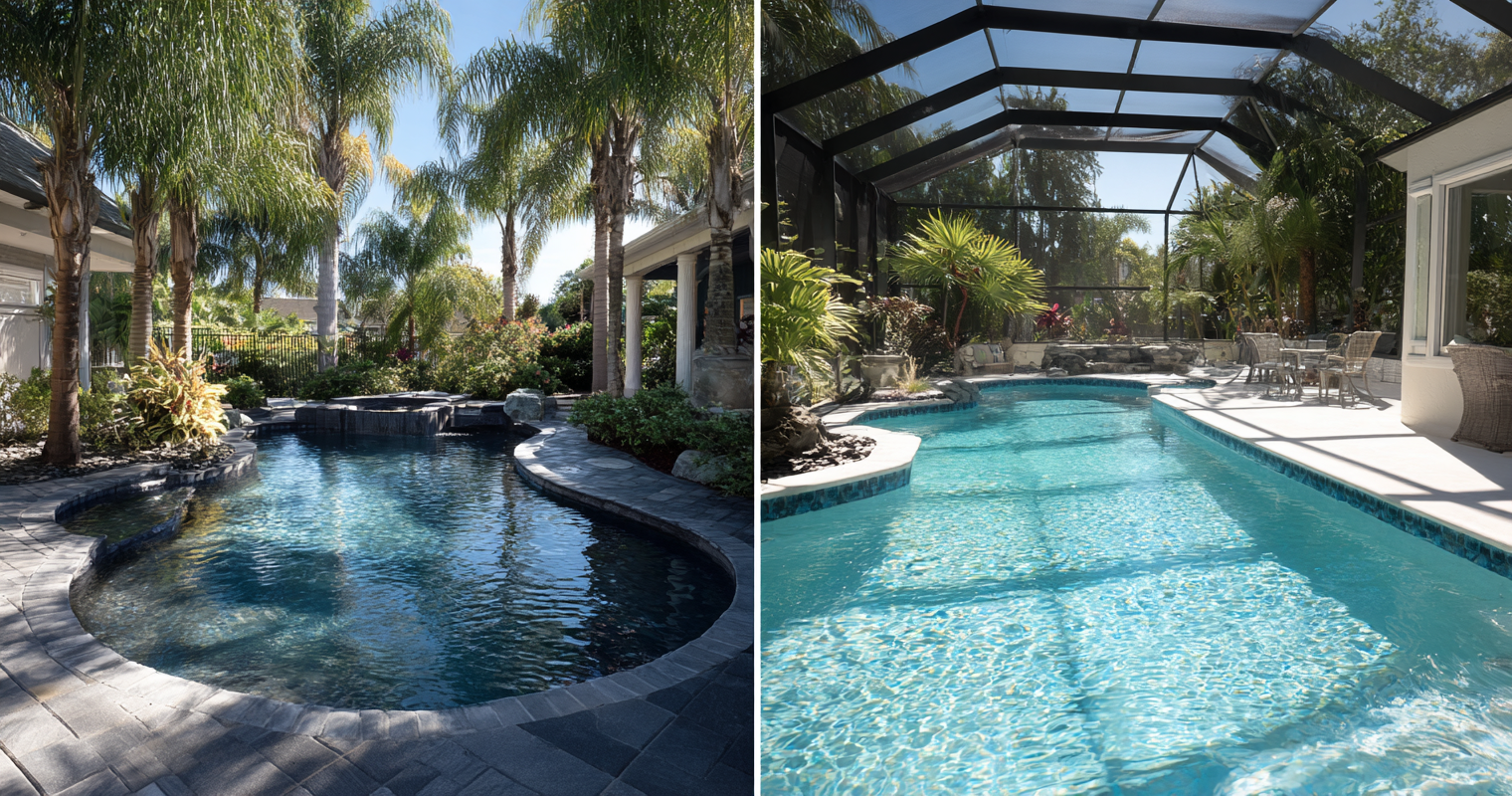
Freeform suits tropical and naturalistic settings: heavy landscaping, rock features, waterfalls, and a lagoon aesthetic. On a lushly planted lot with mature palms it looks entirely at home. Dropped beside a sharply modern house with minimal planting, it tends to look dated.
It is worth being honest about trends. Elaborate kidney and lagoon shapes read as belonging to a particular era, while rectangles have stayed neutral for decades. If resale is a consideration, geometric is the safer long-term choice — though a well-executed freeform pool integrated with genuine landscaping is timeless in its own right.
Cleaning, Covers, and Enclosures
Robotic and suction cleaners handle geometric pools more efficiently. Straight walls and defined corners give predictable coverage; curves and irregular lobes leave spots that need manual attention. It is a minor difference week to week, but it is real.
Automatic safety covers essentially require a geometric pool. They run on tracks along parallel sides, and a freeform outline rules them out. If an automatic cover is on your list — worth considering with young children — that decision makes the shape choice for you.
Screen enclosures are also simpler and cheaper over a rectangular footprint. Enclosing an irregular outline means either a larger rectangular cage covering wasted area or a more complex and expensive custom frame.
The Short Version
Choose geometric for a smaller lot, a modern or Mediterranean house, an automatic cover, easier cleaning, or a simpler screen enclosure. Choose freeform for a larger lot with real landscaping, a tropical aesthetic, or where an irregular boundary makes a curved outline the natural fit. On a tight Southwest Florida lot, geometric is usually the more practical answer.
Related Pool Topics
Frequently Asked Questions
Is a freeform or geometric pool better?
Geometric suits smaller lots, modern and Mediterranean homes, automatic covers, and simpler screen enclosures. Freeform suits larger, heavily landscaped lots with a tropical aesthetic. On a tight Southwest Florida lot, geometric is usually more practical.
Does a freeform pool cost more?
Slightly. The gunite shell costs about the same either way, but curved coping and waterline tile require more cutting, labour, and waste than straight runs. Expect a modest premium rather than a large one.
Which shape gives more usable swimming space?
Geometric. Freeform pools often have curved shallow lobes that are visually generous but not genuinely swimmable, so a rectangle of the same surface area typically gives more useful water.
Can I get an automatic safety cover on a freeform pool?
Generally no. Automatic covers run on tracks along parallel sides and need a geometric outline. If an automatic cover matters to you, that requirement effectively decides the shape.
Do freeform pools cost more to enclose?
Usually. A screen enclosure over a rectangular footprint is simpler and cheaper. An irregular outline means either a larger cage covering unused area or a more complex custom frame.
Are freeform pools harder to clean?
Marginally. Robotic and suction cleaners cover straight walls and defined corners predictably, while curves and lobes can leave spots needing manual attention.
Which shape is better for resale?
Geometric is the safer long-term choice because rectangles have stayed stylistically neutral for decades, while elaborate lagoon and kidney shapes read as period-specific. A well-integrated freeform pool with genuine landscaping still holds up well.
Can fiberglass pools be freeform?
To a degree. Manufacturers offer curved and freeform moulds, but you are limited to the catalogue. A specific curve that follows your particular boundary is only achievable in gunite.