
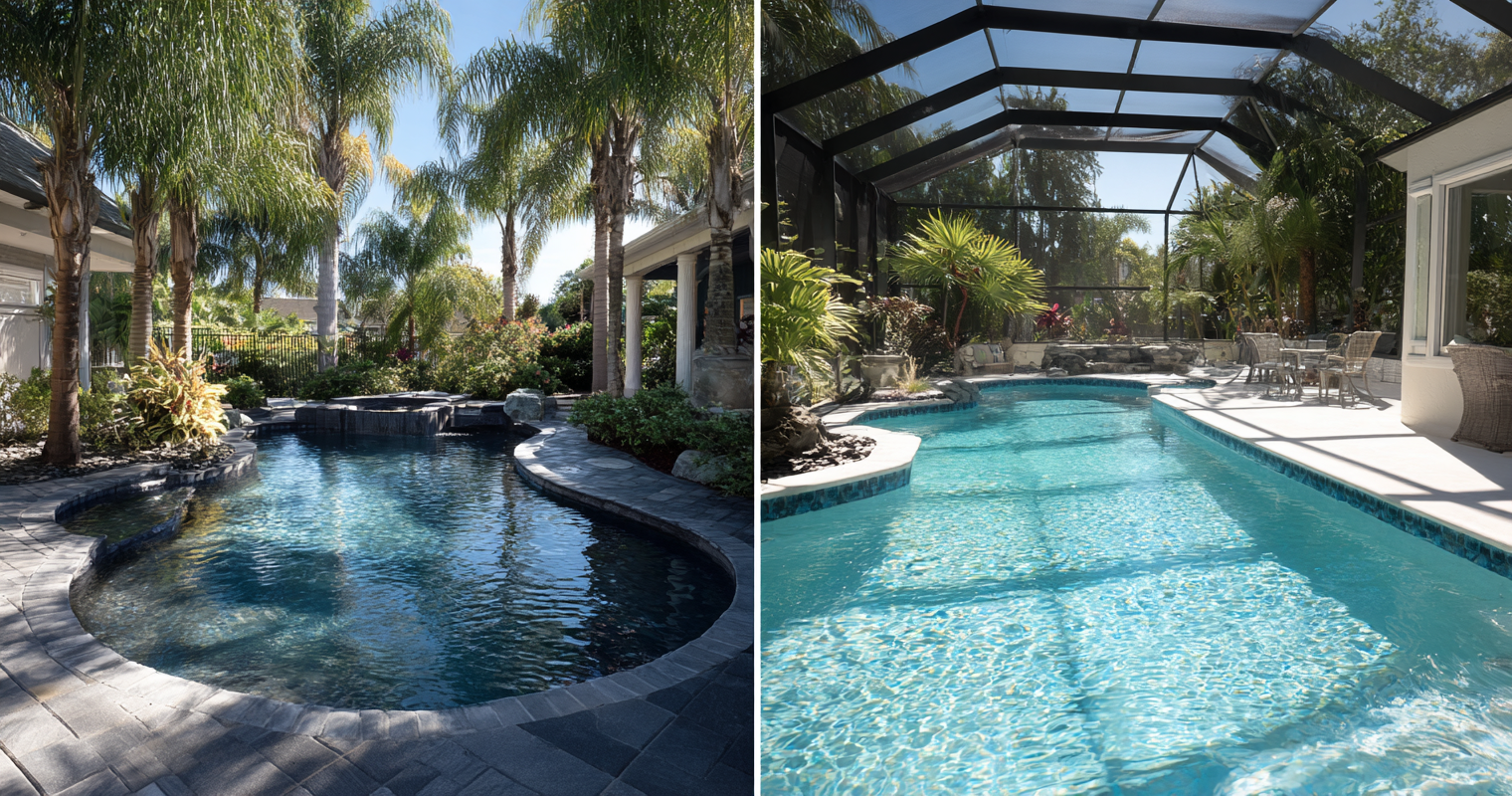
Best Pool Tile for SW Florida Salt Air and Humidity
Waterline tile takes more abuse than any other surface on the pool. Here is what survives salt air, hard water, and relentless sun.
Choosing the best pool tile for Southwest Florida matters more here than in most markets, because waterline tile sits at the intersection of three aggressive conditions: constant wet-dry cycling, hard water that leaves calcium scale, and — within a few miles of the Gulf — salt air working on everything from the outside.
Tile is also the detail people notice most and change least. It is grouted in behind coping and bonded to the shell; replacing it later is disruptive and expensive. Worth getting right the first time.
Glass, Porcelain, and Natural Stone
Porcelain is the practical default. It is fired dense, absorbs almost no water, resists fading, and handles both salt exposure and scale without drama. It is mid-priced, comes in a wide range of looks including convincing stone imitations, and is what most Southwest Florida builders will specify unless you ask otherwise.
Glass tile is the premium option and the one that makes water look extraordinary. It is completely non-porous, so salt and scale sit on the surface rather than penetrating, and the colour will not fade because it runs through the material. It costs considerably more, both for material and for the more demanding installation, and it shows poor workmanship mercilessly.
Natural stone — travertine, marble, and similar — looks superb dry and is the most vulnerable of the three. It is porous, so it absorbs water, stains, and is attacked by salt over time. It also needs sealing on a schedule. It works best on non-salt pools, set back from constant splash.
Scale, Salt, and Sun
Calcium scale is the most common complaint locally. Southwest Florida water is hard, and as water evaporates at the waterline it leaves calcium behind as a chalky band. Every pool gets some. Non-porous surfaces — glass and porcelain — let you clean it off; porous stone lets it bond into the surface, where removal is far harder and can damage the material.
Salt attacks in two directions if you are near the coast: from the pool if you have a salt system, and from the air regardless. Salt crystallising inside a porous material expands and can spall the face off stone over years. Non-porous tile simply does not have that failure mode.
Sun fades pigment. Cheaper tile with surface-applied colour will shift tone over years of direct Florida exposure. Through-body porcelain and glass keep their colour because the colour is not a coating.
Do Not Overlook the Grout
Tile usually outlives its grout. Standard cementitious grout is porous and is often the first thing to fail — staining, eroding, and letting water behind the tile. Epoxy grout costs more and is harder to install, but it is non-porous, resists salt and chemicals, and is the single upgrade most likely to keep a waterline looking right in ten years. If you spend anywhere on this detail, spend it here.
What to Actually Specify
For most Southwest Florida pools: porcelain waterline tile with epoxy grout. It handles salt, scale, and sun, cleans easily, holds colour, and sits at a sensible price. It is the low-regret choice.
If budget allows and the pool is a visual centrepiece — a waterfront lot, an infinity edge, a heavily lit night-use pool — glass tile with epoxy grout is worth the premium. Insist on an installer with specific glass tile experience, because the material exposes sloppy setting.
If you want natural stone, use it on the deck and coping where it stays drier rather than at the waterline, and avoid it entirely at the waterline on a saltwater pool. That gets you the look without putting the vulnerable material where the abuse is worst.
One last practical note: buy extra tile at the time of the build and store it. Tile lines are discontinued constantly, and having matching spares turns a future repair from a visible patch into an invisible one.
Related Pool Topics
Frequently Asked Questions
What is the best pool tile for Southwest Florida?
Porcelain with epoxy grout is the best all-round choice. It is non-porous, resists salt and calcium scale, holds its colour under strong sun, and sits at a reasonable price point. Glass tile is the premium upgrade.
Is glass tile worth it for a pool?
It is if the pool is a visual centrepiece and the budget allows. Glass is completely non-porous, will not fade, and gives water exceptional depth of colour. It costs considerably more and demands an experienced installer, because it shows poor setting work clearly.
Can I use travertine or marble at the waterline?
It is the most vulnerable option. Natural stone is porous, so it stains, absorbs water, and can spall as salt crystallises inside it. Use natural stone on decking and coping where it stays drier, and avoid it at the waterline on saltwater pools.
Why does my pool tile get a white crusty line?
That is calcium scale. Southwest Florida water is hard, and evaporation at the waterline leaves calcium behind. Every pool gets some. On non-porous glass or porcelain it cleans off; on porous stone it bonds in and is much harder to remove.
Does salt water damage pool tile?
Not non-porous tile. Glass and porcelain are unaffected. Porous natural stone is vulnerable, because salt crystallising within the material expands and can break the surface away over years.
What grout should I use for a Florida pool?
Epoxy grout. Standard cementitious grout is porous and is usually the first component to fail, staining and eroding and letting water behind the tile. Epoxy resists salt and chemicals and is the highest-value upgrade at the waterline.
Will pool tile fade in the Florida sun?
Cheaper tile with surface-applied colour will shift tone over years of direct exposure. Through-body porcelain and glass tile hold colour because the colour is integral to the material rather than a coating.
Should I buy spare tile?
Yes. Tile lines are discontinued frequently, and storing a box of spares at build time means a future repair can be matched invisibly instead of patched with something close enough.